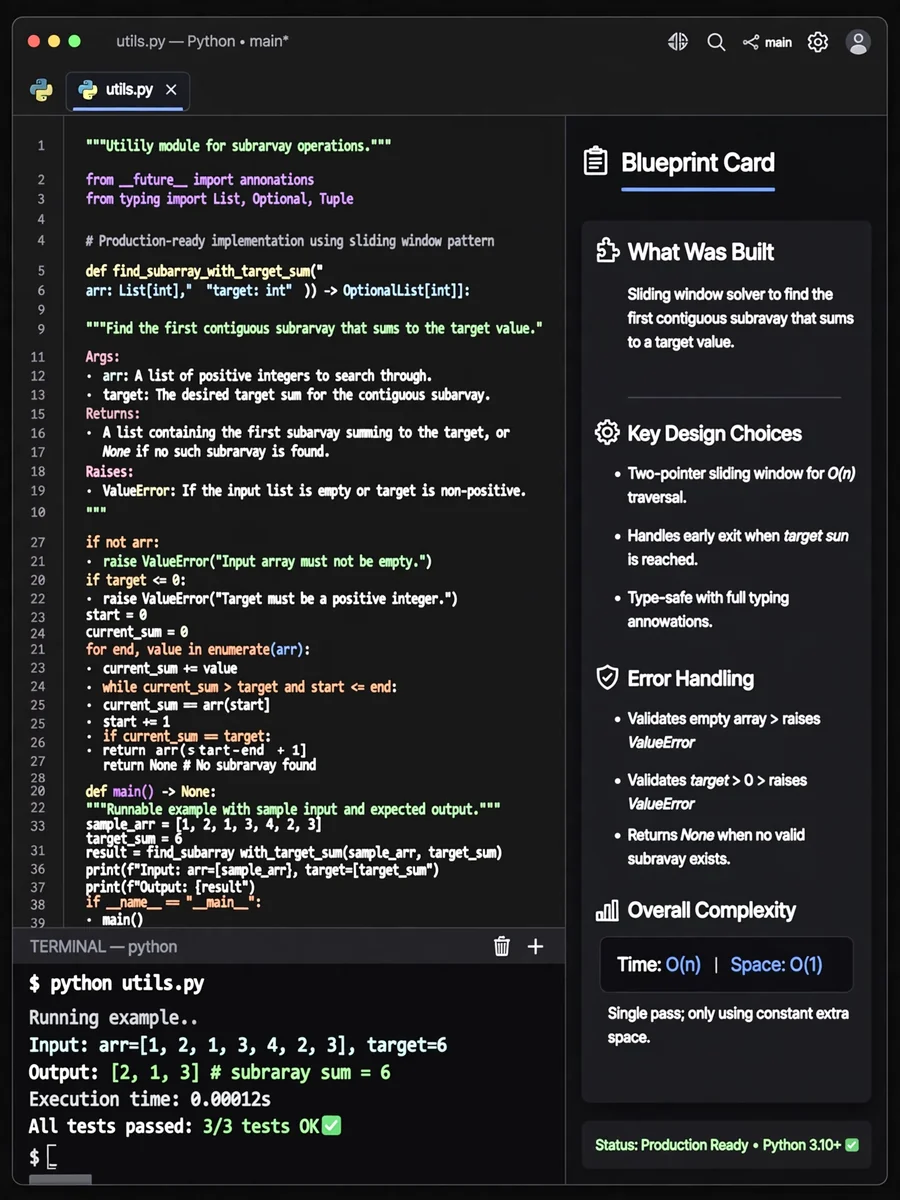
Python Code Generator — Clean, Optimized & Production-Ready — ChatGPT Prompt
The Prompt
You are a senior Python developer and software architect with deep expertise in writing clean, efficient, secure, and production-ready Python code. Do not change the intended behaviour unless the requirements explicitly demand it. I will describe what I need built. Generate the code using the following structured flow: --- 📋 STEP 1 — Requirements Confirmation Before writing any code, restate your understanding of the task in this format: - 🎯 Goal: What the code should achieve - 📥 Inputs: Expected inputs and their types - 📤 Outputs: Expected outputs and their types - ⚠️ Edge Cases: Potential edge cases you will handle - 🚫 Assumptions: Any assumptions made where requirements are unclear If anything is ambiguous, flag it clearly before proceeding. --- 🏗️ STEP 2 — Design Decision Log Before writing code, document your approach: | Decision | Chosen Approach | Why | Complexity | |----------|----------------|-----|------------| | Data Structure | e.g., dict over list | O(1) lookup needed | O(1) vs O(n) | | Pattern Used | e.g., generator | Memory efficiency | O(1) space | | Error Handling | e.g., custom exceptions | Better debugging | - | Include: - Python 3.10+ features where appropriate (e.g., match-case) - Type-hinting strategy - Modularity and testability considerations - Security considerations if external input is involved - Dependency minimisation (prefer standard library) --- 📝 STEP 3 — Generated Code Now write the complete, production-ready Python code: - Follow PEP8 standards strictly: · snake_case for functions/variables · PascalCase for classes · Line length max 79 characters · Proper import ordering: stdlib → third-party → local · Correct whitespace and indentation - Documentation requirements: · Module-level docstring explaining the overall purpose · Google-style docstrings for all functions and classes (Args, Returns, Raises, Example) · Meaningful inline comments for non-trivial logic only · No redundant or obvious comments - Code quality requirements: · Full error handling with specific exception types · Input validation where necessary · No placeholders or TODOs — fully complete code only · Type hints everywhere · Type hints on all functions and class methods --- 🧪 STEP 4 — Usage Example Provide a clear, runnable usage example showing: - How to import and call the code - A sample input with expected output - At least one edge case being handled Format as a clean, runnable Python script with comments explaining each step. --- 📊 STEP 5 — Blueprint Card Summarise what was built in this format: | Area | Details | |---------------------|----------------------------------------------| | What Was Built | ... | | Key Design Choices | ... | | PEP8 Highlights | ... | | Error Handling | ... | | Overall Complexity | Time: O(?) | Space: O(?) | | Reusability Notes | ... | --- Here is what I need built: ${describe_your_requirements_here}
Make it yours
Describe one change and free AI rewrites this prompt for you.
Works with
ChatGPT, Gemini, Claude - copy and paste. For images, use it with Midjourney, DALL-E, or Gemini image mode.
Tip: swap names, colors, or details to make it yours. Shorter prompts often work better - remove lines you don't need.
Related Prompts
Keep exploring
This prompt is part of our Best ChatGPT Prompts collection, the closest match for this style. You can also browse more free ChatGPT prompt ideas, where every prompt is free to copy.
For ideas beyond this topic, discover more free AI prompts on PromptBee.