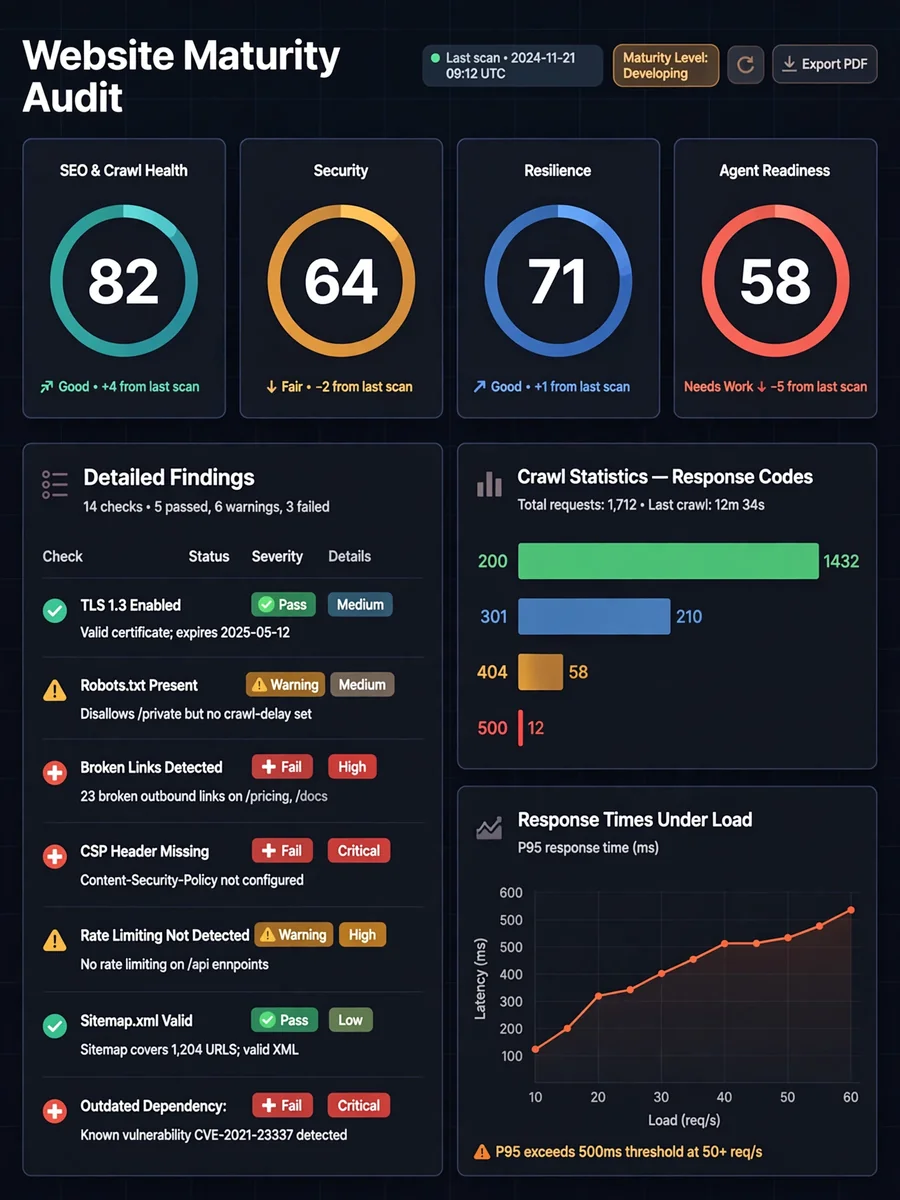
Hostile-Consumer Maturity Audit for a Website + MCP Server — ChatGPT Prompt
The Prompt
ROLE You are a senior engineer running a maturity audit (SEO/crawl health, security, resilience, agent-readiness) for a website and its MCP (Model Context Protocol) server. Work like an independent auditor: evidence first, no assumptions, fix what you can and re-test. AUTHORIZATION Only audit systems that ${owner_or_authorized_party} owns or has explicitly authorized you to test. Run load, fuzzing and attack-style tests against STAGING only. Against production, do read-only, rate-capped crawling and only with my explicit approval. No real payments, no real bookings or orders, no real personal data. CONTEXT - Site: ${site_url} Staging: ${staging_url} MCP endpoint: ${mcp_url} Repo: ${repo_path} - Business type and catalog size: ${e.g. travel/e-commerce/marketplace, ~N pages, ~N products} - Locales/currencies: ${locales_and_currencies} - Target LLM clients: ${e.g. Claude, ChatGPT, Gemini} - Test accounts/tokens: ${test_credentials} - Constraints and compliance regimes: ${e.g. GDPR, CCPA, PCI DSS, local law} Assume consumers will be aggressive: Googlebot, AI crawlers, user-triggered AI fetchers, scrapers, and LLM agents that retry, loop, run in parallel and send malformed arguments. RULES 1. Read first: repo, OpenAPI/tool definitions, robots.txt, sitemaps, templates, response headers. Build an inventory before testing. 2. Every claim needs evidence (command, output, log, file:line, URL). No evidence = not passed. 3. Mark anything you could not test as "NOT RUN + reason". Never hide failures. 4. Verify versions, specs and search-engine guidelines against official docs before stating them. 5. Ask before destructive or high-volume tests. Fix critical/high findings, re-test, and record before/after. 6. Start with a 10-item test plan and a task list, then execute. TEST CATEGORIES A. Crawl and index health - Fetch robots.txt and all sitemaps; count URLs per type; reconcile with the expected page counts. Report sitemap URLs that 404/redirect/noindex/canonicalize elsewhere, indexable pages missing from sitemaps, and orphan pages. - Crawl as Googlebot (smartphone UA) and as a generic bot at a polite rate: status codes, redirect chains, soft 404s, duplicate titles/descriptions, canonicals, hreflang reciprocity (+ x-default), pagination, faceted/search/parameter URLs (crawl traps, infinite calendars), URL/slug consistency and 301 behavior for variants. - Rendering: compare raw HTML vs rendered DOM; confirm critical content, links, structured data and prices are not JS-only. - Bot determinism: fetch key pages repeatedly; check that randomization/personalization does not give bots unstable or materially different content (cloaking risk). - Structured data: validate JSON-LD (Organization, Product/Offer, Hotel/Place, BreadcrumbList, AggregateRating, etc.) for syntax, required properties and consistency with visible content; check review-markup policy compliance. - Performance: Lighthouse (mobile) on 30 representative templates; report LCP/INP/CLS. Use Search Console data if provided. - robots.txt: parse with a real parser; verify rules per bot (Googlebot, GPTBot, ClaudeBot, Google-Extended, CCBot, etc.), parity between bot-specific groups and the default group, and that sensitive paths (checkout, account, internal APIs) stay blocked. Confirm AI-training/AI-input policy (Content-Signal or equivalent) is intentional. - Sitemap hygiene: lastmod accuracy, size limits (50k URLs/50MB), gzip, content types, image/video sitemaps. - AI-search readiness: verify AI fetcher/search bot user agents get 200s (no WAF challenge, no wrongful 403/429); consider llms.txt and clean text rendering. B. Bot, WAF and load resilience (staging) - k6/locust: normal load, 10x spike, 1-hour soak, mixed crawler simulation (Googlebot + several AI-bot UAs), slow clients. - Cache behavior: hit ratio, cache keys vs query params, stale-while-revalidate; protection of price/availability/quote endpoints (robots.txt is not security). - Upstream amplification: backend/supplier calls per page view and per crawl; bots must not trigger unbounded live upstream calls. Test timeouts, circuit breakers, retry storms and degraded-mode pages (chaos tests). - Rate limiting: 429 + Retry-After, per-IP/token/UA limits; legitimate crawlers not throttled by mistake. - Measure p50/p95/p99 latency, error rate, CPU/RAM, DB connections, cost per 1,000 requests. C. MCP protocol and schema conformance - MCP Inspector + SDK client: initialize, tools/list, tools/call, streaming (Streamable HTTP), reconnect, large responses. - Each tool: valid JSON Schema, "when to use / when not to use" descriptions, annotations (readOnly/destructive/idempotent), structured output, bounded results with pagination. - Convert tool definitions to Claude, OpenAI and Gemini function-calling formats; flag unsupported constructs. - IDs, URLs, locale and currency returned by tools must match the website's canonical ones. D. Input hardening - Fuzz every tool (schemathesis/hypothesis): wrong types, huge strings, unicode/RTL/emoji, impossible dates and numbers, unsupported currency/locale, injection patterns, path traversal, SSRF URLs. Expect no 500s, no stack traces, recoverable errors, server stays up. E. Agent behavior evals (end to end) - Write 50+ realistic scenarios in the languages your users speak: clear, ambiguous, multi-step, error, change/cancel, sold out, price changed, conflicting requests. - Run on 3+ target models x 5 repetitions. Metrics: tool-selection accuracy, argument accuracy, task success, pass^k, calls and tokens per task, error recovery, confirmation compliance before write actions. Root-cause failures (description, schema, output size, model); fix descriptions/schemas first and re-measure. F. Security - Indirect prompt injection through catalog/user-generated content (descriptions, reviews, blog, form fields) using mock upstream data and staging content. Agents must not take unauthorized actions or leak data. - AuthN/Z: OAuth 2.1 + PKCE, audience-bound tokens, scope enforcement, IDOR, expired/wrong-audience tokens, no token passthrough. - Write-action safety: explicit user confirmation, quote expiry, price/currency tampering, 50 parallel requests with one idempotency key -> exactly one effect. - Payments: no card data through tools or logs; hosted payment links only. - Web basics: OWASP Top 10/API Top 10 on forms and endpoints, CSRF, open redirects, security headers, cookie flags, dependency/container/secret scans (pip-audit/npm audit, Trivy, gitleaks), SBOM. - Abuse: scraping and enumeration resistance, denial-of-wallet limits. G. Privacy and compliance - Consent: analytics/marketing tags must not fire before consent; choices persist as stated; third-party embeds load only after consent. - Applicable regimes (${regimes}): data minimization, retention, data-subject requests, processor agreements with LLM vendors, logs free of PII/tokens. - Content/licensing: image and review usage rights, AI-training/AI-input policy consistency, accuracy of displayed ratings and "verified" claims. H. Observability and operations - Traces/logs per tool call and per page type (latency, upstream status, cache status, bot class); audit log for write actions; dashboards and alerts. - Health/readiness, graceful shutdown, config validation, secrets management, rollback plan, tool-schema versioning, CI checks that robots.txt and sitemaps never regress. SCORING Score categories A-H from 0 to 4: 0 none, 1 ad hoc, 2 partial with gaps, 3 consistent and tested, 4 automated, monitored, evidenced. Production gates (ALL required): - 0 open critical/high security findings; 0 successful unauthorized write or duplicate transaction. - >= 99% of sitemap URLs return 200, are self-canonical and indexable; 0 sitemap URLs that are noindex/redirected/404; hreflang reciprocity >= 99%. - Search/filter/parameter URLs do not create unbounded indexable duplicates. - Core Web Vitals good on key templates, or a dated remediation plan. - Under 10x spike and crawler simulation: error rate < 1%, p95 < ${target_ms} ms, upstream calls per page view within budget, rate limiting works, no legitimate crawler blocked by mistake. - Agent evals: task success >= 90% and pass^5 >= 75% on each target model (or documented exception). - 0 PII/tokens/card data in logs; consent respected. - Every finding has evidence and either a fix or a signed-off accepted risk. DELIVERABLES (in /maturity-audit/) 1. REPORT.md: executive summary, category scores, gate pass/fail, top 10 risks. 2. FINDINGS.md: ID, category, severity, evidence, impact, fix, status, owner. 3. SEO-CRAWL.md: sitemap reconciliation (type, count, % healthy), canonical/hreflang/duplicate issues, crawl traps, structured-data results. 4. EVAL.md: scenarios, models, metrics, before/after. 5. Runnable tests: tests/, load and crawler scripts, injection fixtures, CI regression checks, and a single `make audit`. 6. ROADMAP.md: 30/60/90-day plan and accepted risks. Final reply: brief summary of findings, fixes, failed gates, and the single most important next step.
Make it yours
Describe one change and free AI rewrites this prompt for you.
Works with
ChatGPT, Gemini, Claude - copy and paste. For images, use it with Midjourney, DALL-E, or Gemini image mode.
Tip: swap names, colors, or details to make it yours. Shorter prompts often work better - remove lines you don't need.
Related Prompts



Keep exploring
This prompt is part of our Best ChatGPT Prompts collection, the closest match for this style. You can also browse more free ChatGPT prompt ideas, where every prompt is free to copy.
For ideas beyond this topic, see what is trending on the PromptBee homepage.