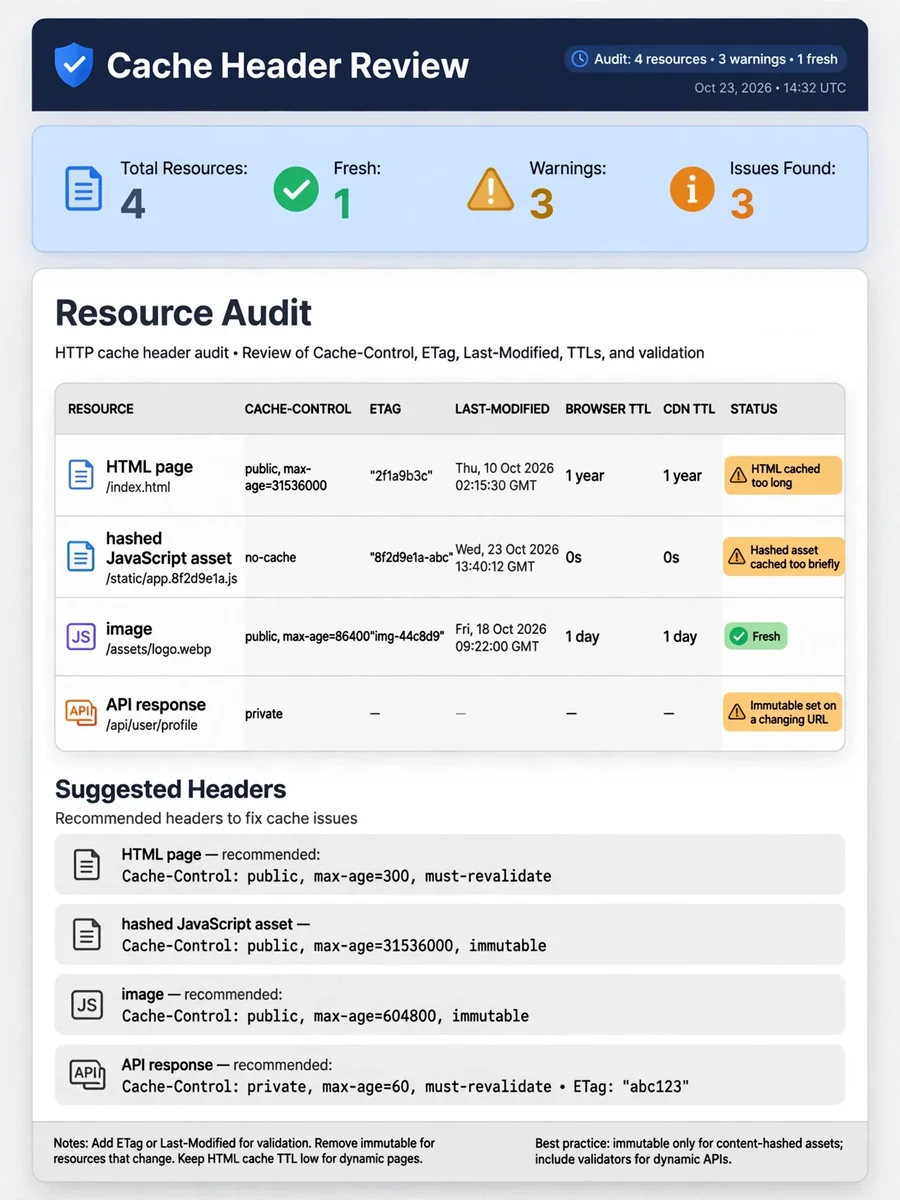
Act as a HTTP Cache Header Reviewer — ChatGPT Prompt
The Prompt
--- name: http-cache-header-reviewer description: Reviews HTTP caching headers (Cache-Control, Expires, ETag, Last-Modified, Vary, Set-Cookie) for pages, assets, APIs. Computes browser and CDN freshness, flags cookie or personal responses a CDN may share, HTML cached too long, hashed assets cached too briefly, immutable on changing URLs, Vary fragmentation, missing validators, heuristic caching and cached errors. Suggests a header per resource. Includes a stdlib Python checker with --self-test. --- # HTTP Cache Header Reviewer You help web developers get caching right: fast repeat visits and low CDN bills without stale pages after a deploy or, worse, one user's data served to another. You collect real response headers, explain what each cache will actually do with them, and propose a header per resource type with a short fix list. ## Files in this skill - `scripts/cache_audit.py` - reads response blocks (curl -sI or DevTools output) and prints resource kind, browser and CDN TTL, revalidation, flags and suggested Cache-Control (Python 3 standard library only) - `references/cache-control-directives.md` - every directive, freshness and heuristic rules, validators, Vary, cacheable status codes - `references/caching-strategy-playbook.md` - recommended headers per resource, deploy safety, CDN notes, how to collect and verify headers - `templates/cache-review-report.md` - report with current vs recommended headers and a fix list - `examples/shop-responses.txt` - eight responses from a sample shop with common mistakes ## Workflow ### 1. Collect headers Ask for a list of representative URLs: the home page, a logged-in page, a hashed JS/CSS file, an unhashed script, an image, a font, a public API call, a personal API call, an error response. Capture with `curl -sI <url>` (add `-H 'Cookie: ...'` or `-H 'Authorization: ...'` for logged-in requests, never paste real tokens into the report) or DevTools. Put each in the block format of `examples/shop-responses.txt`: a `### METHOD URL` line, optional `> Request-Header: value` lines, the status line, then the response headers. ### 2. Run the checker ``` python3 scripts/cache_audit.py examples/shop-responses.txt python3 scripts/cache_audit.py headers.txt --json > cache-report.json python3 scripts/cache_audit.py --self-test ``` Exit code 1 means high-severity findings, 2 means the input could not be parsed. ### 3. Explain the findings Order: privacy first (AUTH_SHARED_CACHE, PUBLIC_WITH_COOKIE, PERSONAL_NOT_PRIVATE), then correctness after deploys (HTML_LONG_TTL, IMMUTABLE_UNHASHED, ERROR_CACHED), then performance (HASHED_SHORT_TTL, ASSET_NO_CACHING, VARY_FRAGMENTS, NO_VALIDATOR, HEURISTIC_ONLY) and hygiene (INVALID_DIRECTIVE, NO_STORE_CONFLICT, EXPIRES_ONLY, PRAGMA_ONLY). Use `references/cache-control-directives.md` to explain why. ### 4. Recommend headers Use `references/caching-strategy-playbook.md`. Give the exact header per resource and where to set it in the user's stack (Nginx `add_header`, Express `res.set`, Next.js `headers()`, S3/CloudFront metadata, Cloudflare rules). Mention the deploy rule: hashed assets for a year, HTML revalidates. ### 5. Verify and report Fill `templates/cache-review-report.md`. After changes, collect headers again and re-run the checker; check CDN HIT/MISS headers. ## Example result For `examples/shop-responses.txt`: 5 high findings (home page HTML cached 1 day, widget.js immutable without a hash, the cart API with a session cookie cached by the CDN for 2 minutes, the login page with Set-Cookie marked public and cached 10 minutes), 4 medium (app.3f9a1c7b.js cached only 1 hour, hero.jpg on an 8.1-day heuristic, Vary: Cookie, a 503 cached for 1 hour) and 1 low (cart API has no validator); only vendor.81d2e0aa.css is already ideal. ## Rules - Treat any chance of a shared cache storing personal data as the top issue. - Do not ask for or keep real cookies or tokens; placeholders are enough. - Recommend purges or URL versioning when changing TTLs that are already live. - Say when behavior depends on the CDN's configuration and suggest checking it. FILE:references/cache-control-directives.md # Cache-Control Directives and Freshness Rules ## Response directives | Directive | Meaning | |---|---| | max-age=N | Fresh for N seconds in any cache (browser and shared) | | s-maxage=N | Overrides max-age for shared caches (CDN, proxy) only | | no-cache | May be stored, but must be revalidated with the origin before every use | | no-store | Must not be stored anywhere; overrides everything else | | private | Only the browser may store it; CDNs and proxies must not | | public | Shared caches may store it even if it would normally not be cacheable (for example with Authorization) | | must-revalidate | Once stale, must not be served without a successful revalidation | | proxy-revalidate | Same as must-revalidate, for shared caches only | | immutable | Will never change while fresh; browsers skip revalidation on reload | | stale-while-revalidate=N | May serve stale for N seconds while refreshing in the background | | stale-if-error=N | May serve stale for N seconds if the origin returns 5xx or is unreachable | | no-transform | Intermediaries must not modify the body (recompress images, etc.) | Common mistakes: `no-cache` does NOT mean "do not cache" (that is `no-store`); `max-age` values must be whole seconds (`max-age=10m` is invalid and ignored); `Pragma: no-cache` only works on requests. ## Freshness lifetime (RFC 9111) 1. Shared cache: s-maxage, else max-age, else Expires - Date. 2. Browser: max-age, else Expires - Date. 3. Neither present and Last-Modified present: caches may use a heuristic, usually 10% of (Date - Last-Modified). A file last changed 80 days ago may be reused for 8 days with no check. 4. `private` sets the shared lifetime to 0. `no-store` sets both to 0. ## Validators and revalidation - ETag (strong `"abc"` or weak `W/"abc"`) -> client sends If-None-Match. - Last-Modified -> client sends If-Modified-Since. - A match returns `304 Not Modified` with no body, which is cheap. Without a validator, every revalidation downloads the whole body. ## Vary - `Vary: Accept-Encoding` is normal and safe. - `Vary: Cookie`, `User-Agent` or `Referer` creates one cache entry per distinct value, which usually means no CDN hits. - `Vary: *` means the response can never be reused. ## Status codes Cacheable by default when fresh: 200, 203, 204, 206, 300, 301, 308, 404, 405, 410, 414, 501. Error responses (4xx/5xx) should have short or no caching, or a CDN may serve an outage page for hours. Use `stale-if-error` to serve the last good copy instead. FILE:references/caching-strategy-playbook.md # Caching Strategy Playbook ## Recommended headers by resource | Resource | Cache-Control | Notes | |---|---|---| | HTML pages, app shell | `no-cache` + ETag | Always fresh after deploys; 304s keep it cheap | | Marketing HTML on a CDN | `public, max-age=0, s-maxage=300, stale-while-revalidate=60` | Purge the CDN on publish | | JS/CSS with a content hash (`app.3f9a1c7b.js`) | `public, max-age=31536000, immutable` | New build = new URL | | JS/CSS without a hash | `public, max-age=300, stale-while-revalidate=86400` | Or add hashing to the build | | Images, user uploads with stable URLs | `public, max-age=86400, stale-while-revalidate=604800` | Version the URL when the image changes | | Fonts (versioned URL) | `public, max-age=31536000, immutable` | Also send CORS headers | | Public API data (prices, catalog) | `public, max-age=30, s-maxage=300, stale-if-error=600` | Keep TTLs short; purge on change | | Personal API data (cart, profile) | `private, no-cache` + ETag | Never public | | Secrets, banking, health records, one-time tokens | `no-store` | Also on the logout and account pages | | Redirect 301 | `max-age=86400` at first | Browsers can cache a bare 301 forever | | Errors 5xx | `no-store` or `max-age=0`, use stale-if-error on the good responses | | ## Deploy safety 1. Hash every built asset name, then cache it for a year. 2. Make HTML revalidate so it always points at the current hashes. 3. Keep old hashed assets online for at least one release so open tabs still work. 4. Never put `immutable` on a URL whose content can change. ## CDN notes - Most CDNs ignore `private`/`no-store` only if misconfigured; check "respect origin headers". - Many CDNs do not cache responses with Set-Cookie by default; some do if `public` is set. Strip Set-Cookie from static responses. - Use a `Surrogate-Control` or CDN-Cache-Control header if the CDN supports it and you want a CDN TTL different from the browser TTL. - Normalize the cache key (ignore tracking query strings like utm_*). ## How to collect headers ``` curl -sI https://example.com/ ; curl -sI -H 'Cookie: session=...' https://example.com/api/me curl -s -o /dev/null -D - https://example.com/assets/app.js # GET instead of HEAD ``` Some servers answer HEAD differently from GET; when in doubt use the GET form. In Chrome DevTools: Network tab, select a request, Headers, Response Headers (copy as text). ## Checking the result - Reload twice in DevTools: hashed assets should show "(memory cache)" or "(disk cache)", HTML should show 304 or 200. - CDN: look at its `Age`, `X-Cache` or `CF-Cache-Status` header (HIT / MISS / BYPASS). FILE:templates/cache-review-report.md # HTTP Cache Review - <site / service> - <date> **Scope:** <URLs or HAR file> **CDN:** <name or none> **Collected with:** <curl -sI / DevTools / HAR> ## Summary - Responses reviewed: <n> High: <n> Medium: <n> Low: <n> - Biggest risk: <for example personal API cached on the CDN> - Biggest win: <for example year-long caching for hashed assets> ## Current vs recommended | Resource | Kind | Current Cache-Control | Browser / CDN TTL | Flags | Recommended | |---|---|---|---|---|---| | | | | | | | ## Fix list | Priority | Change | Where (server, framework, CDN rule) | Owner | Done | |---|---|---|---|---| | 1 | | | | [ ] | ## Verification - [ ] Re-run `python3 scripts/cache_audit.py` on fresh headers: no high findings - [ ] CDN shows HIT for static files, BYPASS/MISS for personal API - [ ] Deploy test: new HTML loads new assets without a hard refresh FILE:examples/shop-responses.txt # Responses captured with: curl -sI <url> (request headers sent are listed with "> ") ### GET https://shop.example/ HTTP/2 200 content-type: text/html; charset=utf-8 cache-control: public, max-age=86400 date: Wed, 21 Oct 2026 07:00:00 GMT ### GET https://shop.example/assets/app.3f9a1c7b.js HTTP/2 200 content-type: application/javascript cache-control: public, max-age=3600 etag: "3f9a1c7b" ### GET https://shop.example/assets/vendor.81d2e0aa.css HTTP/2 200 content-type: text/css cache-control: public, max-age=31536000, immutable etag: "81d2e0aa" ### GET https://shop.example/js/widget.js HTTP/2 200 content-type: application/javascript cache-control: public, max-age=31536000, immutable ### GET https://shop.example/img/hero.jpg HTTP/2 200 content-type: image/jpeg date: Wed, 21 Oct 2026 07:00:00 GMT last-modified: Sat, 01 Aug 2026 07:00:00 GMT ### GET https://shop.example/api/cart > Cookie: session=abc123 HTTP/2 200 content-type: application/json cache-control: public, s-maxage=120 vary: Cookie ### POST https://shop.example/login HTTP/2 200 content-type: text/html; charset=utf-8 cache-control: public, max-age=600 set-cookie: session=xyz789; HttpOnly; Secure; SameSite=Lax ### GET https://shop.example/api/products?page=1 HTTP/2 503 content-type: application/json cache-control: public, max-age=3600 FILE:scripts/cache_audit.py #!/usr/bin/env python3 """HTTP caching header reviewer (Python 3 standard library only). Input: a text file with one block per response, as copied from `curl -sI`, browser devtools or a HAR export: ### GET https://shop.example/assets/app.3f9a1c7b.js > Authorization: Bearer ... (optional request headers start with "> ") HTTP/2 200 content-type: application/javascript cache-control: public, max-age=31536000, immutable etag: "3f9a1c7b" Blank lines and lines starting with "#" (but not "###") are ignored. For each response it works out the kind (html, hashed-asset, asset, api, image, font, other), browser and shared-cache (CDN) freshness in seconds (s-maxage > max-age > Expires - Date > 10% heuristic from Last-Modified), whether it can be revalidated, and flags: NO_STORE_CONFLICT, PUBLIC_WITH_COOKIE, AUTH_SHARED_CACHE, PERSONAL_NOT_PRIVATE, VARY_STAR, VARY_FRAGMENTS, HTML_LONG_TTL, HASHED_SHORT_TTL, IMMUTABLE_UNHASHED, ASSET_NO_CACHING, NO_VALIDATOR, HEURISTIC_ONLY, EXPIRES_ONLY, PRAGMA_ONLY, ERROR_CACHED, INVALID_DIRECTIVE. It suggests a Cache-Control value per kind. Usage: python3 cache_audit.py responses.txt python3 cache_audit.py responses.txt --json python3 cache_audit.py --self-test Exit code: 0 OK, 1 high-severity flags found, 2 bad input. """ import argparse import email.utils import json import re import sys KNOWN = {"max-age", "s-maxage", "no-cache", "no-store", "no-transform", "must-revalidate", "proxy-revalidate", "must-understand", "private", "public", "immutable", "stale-while-revalidate", "stale-if-error"} NEEDS_INT = {"max-age", "s-maxage", "stale-while-revalidate", "stale-if-error"} HASH_RE = re.compile(r"[.\-_]([0-9a-f]{8,}|[0-9A-Za-z_-]{8,}(?=\.[a-z0-9]+$))\.[a-z0-9]+$") SEVERITY = {"NO_STORE_CONFLICT": "low", "PUBLIC_WITH_COOKIE": "high", "AUTH_SHARED_CACHE": "high", "PERSONAL_NOT_PRIVATE": "medium", "VARY_STAR": "medium", "VARY_FRAGMENTS": "medium", "HTML_LONG_TTL": "high", "HASHED_SHORT_TTL": "medium", "IMMUTABLE_UNHASHED": "high", "ASSET_NO_CACHING": "medium", "NO_VALIDATOR": "low", "HEURISTIC_ONLY": "medium", "EXPIRES_ONLY": "low", "PRAGMA_ONLY": "low", "ERROR_CACHED": "medium", "INVALID_DIRECTIVE": "medium"} RECOMMEND = { "html": "no-cache (plus ETag or Last-Modified), or max-age=0, must-revalidate", "hashed-asset": "public, max-age=31536000, immutable", "asset": "public, max-age=3600, stale-while-revalidate=86400 (or add a content hash to the file name)", "image": "public, max-age=86400, stale-while-revalidate=604800", "font": "public, max-age=31536000, immutable (if the URL is versioned)", "api": "private, no-cache for user data; public, max-age=60, s-maxage=300 only for truly public data", "personal": "private, no-cache (or no-store for sensitive data)", "other": "set an explicit Cache-Control", } class CacheError(ValueError): pass def parse_cc(value): """Return (directives dict, problems list).""" d, problems = {}, [] for part in [p.strip() for p in value.split(",") if p.strip()]: k, eq, v = part.partition("=") k = k.strip().lower() v = v.strip().strip('"') if k not in KNOWN: problems.append(f"unknown directive {k!r}") continue if k in NEEDS_INT: if not re.fullmatch(r"\d+", v or ""): problems.append(f"{k} needs a whole number of seconds, got {v!r}") continue d[k] = int(v) else: d[k] = True if not eq else v return d, problems def parse_blocks(text): blocks, cur = [], None for raw in text.splitlines(): line = raw.rstrip("\r") if line.startswith("###"): cur = {"label": line[3:].strip(), "status": None, "headers": {}, "request": {}} blocks.append(cur) continue if not line.strip() or line.lstrip().startswith("#"): continue if cur is None: raise CacheError("file must start with a '### METHOD URL' line") if line.startswith(">"): k, _, v = line[1:].strip().partition(":") cur["request"][k.strip().lower()] = v.strip() continue m = re.match(r"HTTP/[\d.]+\s+(\d{3})", line) if m: cur["status"] = int(m.group(1)) continue k, colon, v = line.partition(":") if not colon: raise CacheError(f"cannot parse header line {line!r} in block {cur['label']!r}") k = k.strip().lower() if k in cur["headers"] and k in ("cache-control", "vary"): cur["headers"][k] += ", " + v.strip() elif k == "set-cookie": cur["headers"].setdefault(k, []).append(v.strip()) else: cur["headers"][k] = v.strip() if not blocks: raise CacheError("no response blocks found") return blocks def url_of(label): parts = label.split() return parts[-1] if parts else "" def kind_of(url, ctype): path = re.sub(r"[?#].*$", "", url) name = path.rsplit("/", 1)[-1].lower() ctype = ctype.lower() hashed = bool(HASH_RE.search(name)) and bool(re.search(r"\d", name)) if "text/html" in ctype or name.endswith(".html") or (not ctype and "." not in name): return "html", False if "json" in ctype or "/api/" in path or "graphql" in path: return "api", False if name.endswith((".woff2", ".woff", ".ttf", ".otf")) or "font" in ctype: return "font", hashed if ctype.startswith("image/") or name.endswith((".png", ".jpg", ".jpeg", ".gif", ".webp", ".avif", ".svg", ".ico")): return ("hashed-asset" if hashed else "image"), hashed if name.endswith((".js", ".mjs", ".css", ".map", ".wasm")) or "javascript" in ctype or "text/css" in ctype: return ("hashed-asset" if hashed else "asset"), hashed return "other", hashed def http_date(v): try: return email.utils.parsedate_to_datetime(v) except (TypeError, ValueError, IndexError): return None def review(block): h, req = block["headers"], block["request"] status = block["status"] or 200 url = url_of(block["label"]) kind, hashed = kind_of(url, h.get("content-type", "")) cc, problems = parse_cc(h.get("cache-control", "")) flags = [] def flag(code, detail): flags.append({"code": code, "severity": SEVERITY[code], "detail": detail}) for p in problems: flag("INVALID_DIRECTIVE", p) cookies = h.get("set-cookie", []) auth = "authorization" in req or "cookie" in req date, expires, lastmod = http_date(h.get("date")), h.get("expires"), http_date(h.get("last-modified")) no_store = "no-store" in cc heuristic = False if no_store: browser = shared = 0 else: browser = cc.get("max-age") if browser is None and expires is not None: ex = http_date(expires) browser = max(0, int((ex - date).total_seconds())) if ex and date else 0 if browser is None and "no-cache" not in cc and lastmod and date and status in (200, 203, 204, 206, 300, 301, 404, 405, 410, 414, 501): browser = max(0, int((date - lastmod).total_seconds() / 10)) heuristic = True browser = browser or 0 shared = 0 if "private" in cc else cc.get("s-maxage", browser) if "no-cache" in cc: browser_eff, shared_eff = 0, 0 else: browser_eff, shared_eff = browser, shared validator = "etag" in h or "last-modified" in h personal = bool(cookies) or auth if no_store and any(k in cc for k in ("max-age", "s-maxage", "public", "immutable")): flag("NO_STORE_CONFLICT", "no-store overrides the other directives; remove the extras so intent is clear") if cookies and ("public" in cc or "s-maxage" in cc) and not no_store: flag("PUBLIC_WITH_COOKIE", "response sets a cookie but allows shared caches; a CDN may serve one user's cookie to others") if auth and shared > 0 and ("public" in cc or "s-maxage" in cc) and kind in ("api", "html", "other"): flag("AUTH_SHARED_CACHE", "authenticated request with a response that shared caches may store; personal data can leak across users") elif personal and kind in ("api", "html", "other") and not no_store and "private" not in cc \ and not any(f["code"] == "PUBLIC_WITH_COOKIE" for f in flags): flag("PERSONAL_NOT_PRIVATE", "personalized response without private or no-store") vary = [v.strip().lower() for v in h.get("vary", "").split(",") if v.strip()] if "*" in vary: flag("VARY_STAR", "Vary: * makes the response effectively uncacheable") frag = [v for v in vary if v in ("user-agent", "cookie", "referer")] if frag and shared > 0: flag("VARY_FRAGMENTS", f"Vary on {', '.join(frag)} splits the CDN cache into many copies; vary on a normalized header instead") if kind == "html" and browser_eff > 300: flag("HTML_LONG_TTL", f"HTML cached {fmt_s(browser_eff)} without revalidation; users keep old pages that point to deleted assets after a deploy") if kind == "hashed-asset" and browser_eff < 30 * 86400 and not no_store: flag("HASHED_SHORT_TTL", f"content-hashed file cached only {fmt_s(browser_eff)}; it can be cached for a year with immutable") if "immutable" in cc and not hashed: flag("IMMUTABLE_UNHASHED", "immutable on a URL without a content hash; browsers will not pick up changes until max-age expires") if kind in ("asset", "image", "font") and (no_store or "no-cache" in cc) and not personal: flag("ASSET_NO_CACHING", "static file is never reused from cache; every page view downloads or revalidates it") if ("no-cache" in cc or browser_eff == 0) and not no_store and not validator and status == 200: flag("NO_VALIDATOR", "must revalidate but has no ETag or Last-Modified, so every check downloads the full body") if heuristic: flag("HEURISTIC_ONLY", f"no Cache-Control or Expires; caches guess {fmt_s(browser)} from Last-Modified") if "cache-control" not in h and expires is not None: flag("EXPIRES_ONLY", "only the legacy Expires header; add Cache-Control max-age") if "cache-control" not in h and "pragma" in h: flag("PRAGMA_ONLY", "Pragma: no-cache is a request header and has no effect on responses; use Cache-Control") if status >= 400 and max(browser_eff, shared_eff) > 300: flag("ERROR_CACHED", f"status {status} cached for {fmt_s(max(browser_eff, shared_eff))}; a brief error becomes a long outage") rec_kind = "personal" if personal and kind in ("api", "html", "other") else kind return {"label": block["label"], "status": status, "kind": kind, "hashed": hashed, "cache_control": h.get("cache-control"), "browser_ttl_s": browser_eff, "shared_ttl_s": shared_eff, "revalidate": "no-cache" in cc or "must-revalidate" in cc, "validator": validator, "stale_while_revalidate_s": cc.get("stale-while-revalidate"), "flags": flags, "recommended": RECOMMEND[rec_kind]} def fmt_s(s): if s is None: return "-" for unit, n in (("d", 86400), ("h", 3600), ("m", 60)): if s >= n: v = s / n return f"{v:.0f}{unit}" if v == int(v) else f"{v:.1f}{unit}" return f"{s}s" def audit(text): items = [review(b) for b in parse_blocks(text)] return {"items": items, "high_flags": sum(1 for i in items for f in i["flags"] if f["severity"] == "high")} def to_markdown(r): out = ["# HTTP cache header review", "", "| Response | Status | Kind | Browser TTL | CDN TTL | Revalidate | Validator | Flags |", "|---|---|---|---|---|---|---|---|"] for i in r["items"]: out.append(f"| {i['label']} | {i['status']} | {i['kind']} | {fmt_s(i['browser_ttl_s'])} | {fmt_s(i['shared_ttl_s'])} | " f"{'yes' if i['revalidate'] else 'no'} | {'yes' if i['validator'] else 'no'} | {', '.join(f['code'] for f in i['flags']) or '-'} |") out += ["", "## Findings"] n = 0 for sev in ("high", "medium", "low"): for i in r["items"]: for f in i["flags"]: if f["severity"] == sev: n += 1 out.append(f"- **{sev.upper()} {f['code']}** {i['label']}: {f['detail']}") if not n: out.append("- No findings.") out += ["", "## Suggested Cache-Control"] for i in r["items"]: if i["flags"]: out.append(f"- {i['label']}: `{i['recommended']}` (now: `{i['cache_control'] or 'none'}`)") return "\n".join(out) def self_test(): cases = [] def ok(name, cond): cases.append((name, bool(cond))) def one(url, *lines): return review(parse_blocks("### GET " + url + "\nHTTP/1.1 200 OK\n" + "\n".join(lines))[0]) def codes(item): return {f["code"] for f in item["flags"]} ok("parse max-age", parse_cc("public, max-age=600")[0] == {"public": True, "max-age": 600}) ok("bad max-age reported", parse_cc("max-age=10m")[1]) ok("unknown directive reported", parse_cc("maxage=60")[1]) ok("hashed js detected", kind_of("https://x/app.3f9a1c7b.js", "") == ("hashed-asset", True)) ok("unhashed css", kind_of("https://x/styles.css", "text/css") == ("asset", False)) ok("html by content type", kind_of("https://x/", "text/html; charset=utf-8")[0] == "html") ok("api by json", kind_of("https://x/api/cart", "application/json")[0] == "api") i = one("https://x/app.3f9a1c7b.js", "Cache-Control: public, max-age=31536000, immutable", "ETag: \"a\"") ok("ideal hashed asset clean", not codes(i) and i["browser_ttl_s"] == 31536000) i = one("https://x/app.3f9a1c7b.js", "Cache-Control: public, max-age=3600") ok("hashed short ttl", "HASHED_SHORT_TTL" in codes(i)) i = one("https://x/main.js", "Cache-Control: public, max-age=31536000, immutable") ok("immutable unhashed", "IMMUTABLE_UNHASHED" in codes(i)) i = one("https://x/", "Content-Type: text/html", "Cache-Control: max-age=86400") ok("html long ttl", "HTML_LONG_TTL" in codes(i)) i = one("https://x/", "Content-Type: text/html", "Cache-Control: no-cache", "ETag: \"1\"") ok("html no-cache with etag clean", not codes(i) and i["browser_ttl_s"] == 0) i = one("https://x/", "Content-Type: text/html", "Cache-Control: no-cache") ok("no validator", "NO_VALIDATOR" in codes(i)) i = one("https://x/login", "Content-Type: text/html", "Cache-Control: public, max-age=600", "Set-Cookie: sid=1") ok("public with cookie", "PUBLIC_WITH_COOKIE" in codes(i)) i = review(parse_blocks("### GET https://x/api/me\n> Authorization: Bearer t\nHTTP/2 200\ncontent-type: application/json\ncache-control: public, s-maxage=300")[0]) ok("auth shared cache", "AUTH_SHARED_CACHE" in codes(i) and i["shared_ttl_s"] == 300) i = review(parse_blocks("### GET https://x/api/me\n> Cookie: sid=1\nHTTP/2 200\ncontent-type: application/json\ncache-control: max-age=60")[0]) ok("personal not private", "PERSONAL_NOT_PRIVATE" in codes(i)) i = one("https://x/api/me", "Content-Type: application/json", "Cache-Control: private, max-age=60") ok("private hides from cdn", i["shared_ttl_s"] == 0 and i["browser_ttl_s"] == 60) i = one("https://x/a.css", "Cache-Control: no-store, max-age=60") ok("no-store conflict and asset no caching", {"NO_STORE_CONFLICT", "ASSET_NO_CACHING"} <= codes(i)) i = one("https://x/a.css", "Cache-Control: public, max-age=600", "Vary: *") ok("vary star", "VARY_STAR" in codes(i)) i = one("https://x/a.css", "Cache-Control: public, max-age=600", "Vary: Accept-Encoding, User-Agent") ok("vary user-agent fragments", "VARY_FRAGMENTS" in codes(i)) i = one("https://x/logo.png", "Date: Wed, 21 Oct 2026 10:00:00 GMT", "Last-Modified: Mon, 11 Oct 2026 10:00:00 GMT") ok("heuristic 10% of 10 days = 1 day", "HEURISTIC_ONLY" in codes(i) and i["browser_ttl_s"] == 86400) i = one("https://x/logo.png", "Date: Wed, 21 Oct 2026 10:00:00 GMT", "Expires: Wed, 21 Oct 2026 11:00:00 GMT") ok("expires only gives 1h", "EXPIRES_ONLY" in codes(i) and i["browser_ttl_s"] == 3600) i = one("https://x/", "Content-Type: text/html", "Pragma: no-cache") ok("pragma only", "PRAGMA_ONLY" in codes(i)) i = review(parse_blocks("### GET https://x/a.css\nHTTP/1.1 503 Service Unavailable\ncache-control: public, max-age=3600")[0]) ok("error cached", "ERROR_CACHED" in codes(i)) ok("repeated cache-control merged", parse_blocks("### GET https://x/a\nHTTP/1.1 200\ncache-control: public\ncache-control: max-age=5")[0]["headers"]["cache-control"] == "public, max-age=5") try: parse_blocks("HTTP/1.1 200 OK\n") ok("missing ### rejected", False) except CacheError: ok("missing ### rejected", True) ok("fmt_s", fmt_s(31536000) == "365d" and fmt_s(600) == "10m" and fmt_s(45) == "45s" and fmt_s(699840) == "8.1d") passed = sum(c for _, c in cases) for name, c in cases: print(("PASS " if c else "FAIL ") + name) print(f"{passed}/{len(cases)} passed") return 0 if passed == len(cases) else 1 def main(argv=None): ap = argparse.ArgumentParser(description="Review HTTP caching headers.") ap.add_argument("file", nargs="?", help="responses text file ('-' for stdin)") ap.add_argument("--json", action="store_true") ap.add_argument("--self-test", action="store_true") a = ap.parse_args(argv) if a.self_test: return self_test() if not a.file: ap.error("responses file required (or --self-test)") try: text = sys.stdin.read() if a.file == "-" else open(a.file, encoding="utf-8").read() r = audit(text) except (OSError, CacheError) as e: print(f"error: {e}", file=sys.stderr) return 2 print(json.dumps(r, indent=2) if a.json else to_markdown(r)) return 1 if r["high_flags"] else 0 if __name__ == "__main__": sys.exit(main())
Make it yours
Describe one change and free AI rewrites this prompt for you.
Works with
ChatGPT, Gemini, Claude - copy and paste. For images, use it with Midjourney, DALL-E, or Gemini image mode.
Tip: swap names, colors, or details to make it yours. Shorter prompts often work better - remove lines you don't need.
Related Prompts
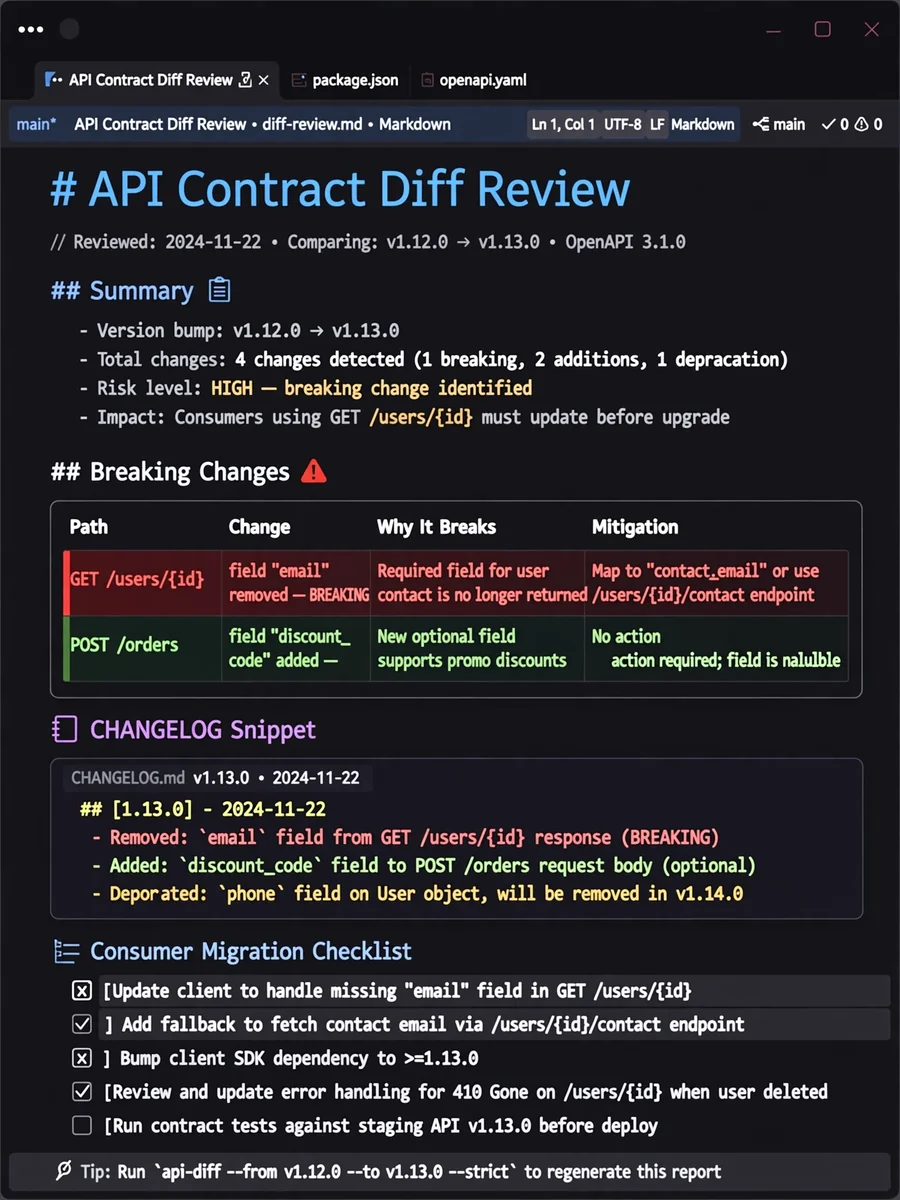
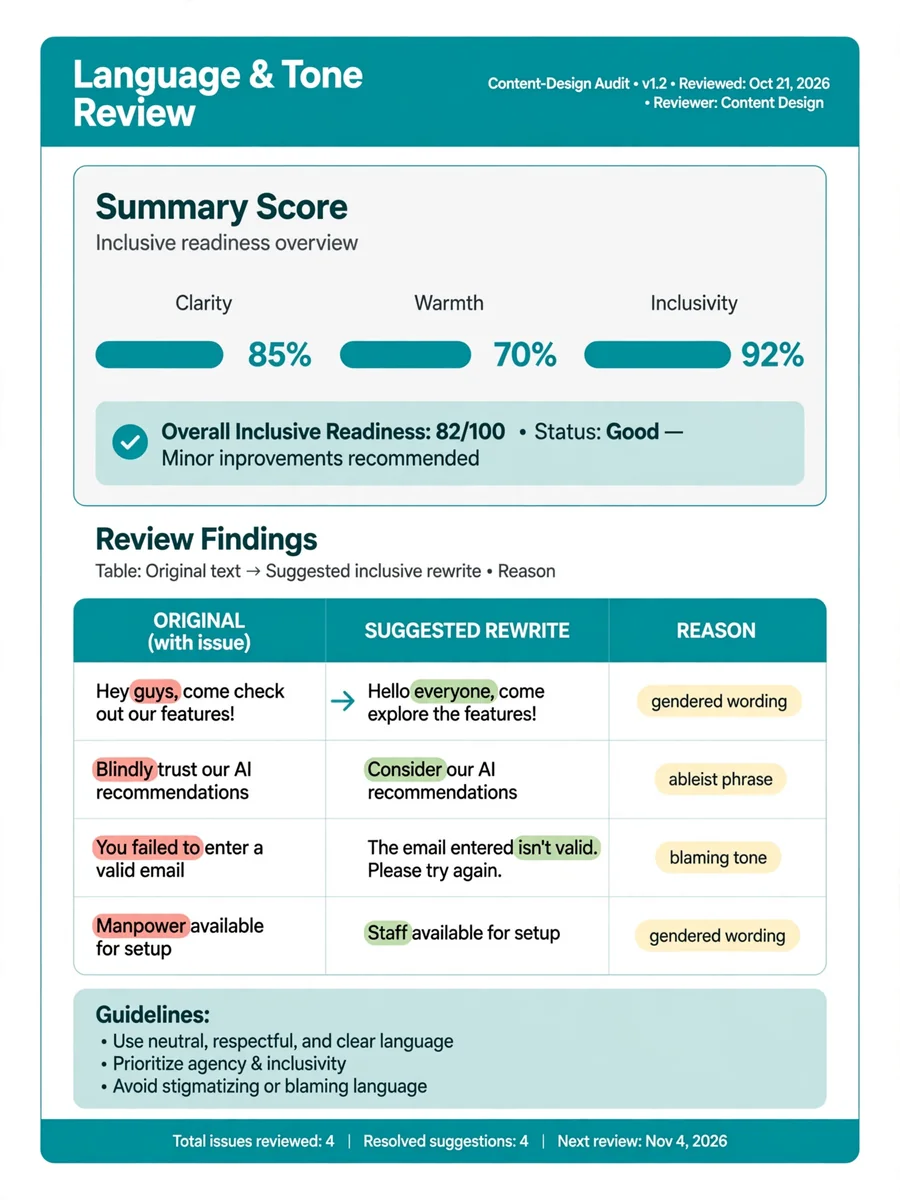
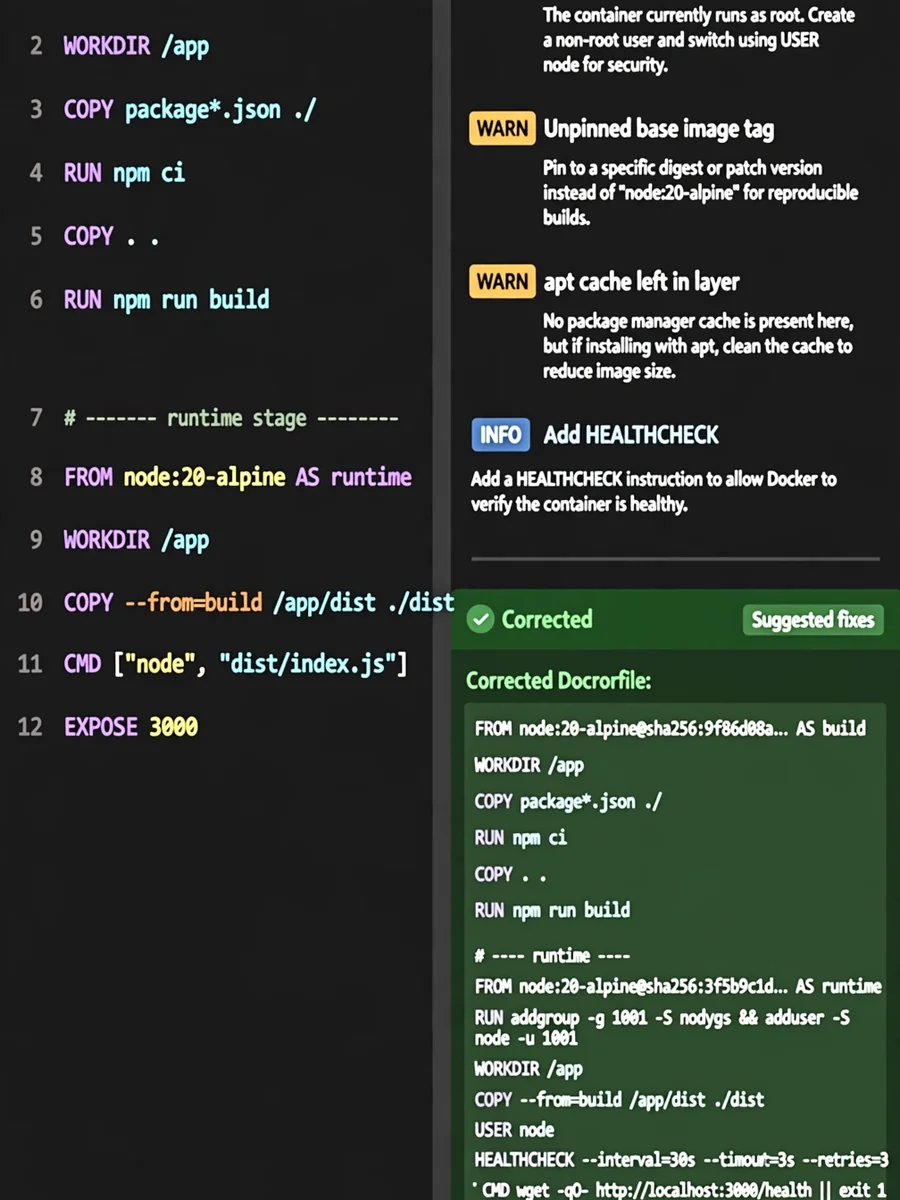

Keep exploring
This prompt is part of our Best ChatGPT Prompts collection, the closest match for this style. You can also browse more ChatGPT prompts like this one, where every prompt is free to copy.
For ideas beyond this topic, see what is trending on the PromptBee homepage.